Computational single-cell biology in research
The computational single-cell biology combines high-throughput sequencing, bioinformatics, statistics, artificial intelligence, and computational modelling to study biological processes at the scale of individual cells.
The increasing availability of data from the single-cell RNA sequencing, spatial transcriptomics, single-cell epigenomics, single-cell proteomics, and multi-omic approaches allows researchers to characterise cell populations with unprecedented molecular resolution.
Computational approaches are used to process large sets of biological data, identify cell populations, characterise molecular states, reconstruct cell trajectories, and study interactions between cells and their microenvironment.
Precision medicine
The precision medicine aims to improve the prevention, diagnosis, and treatment of diseases by taking into account the genetic, molecular, cellular, and clinical characteristics unique to each individual.
Computational biology contributes to precision medicine by integrating genomic, transcriptomic, proteomic, and clinical information to identify molecular profiles associated with diseases and therapeutic response.
Computational approaches can contribute to :
- Personalised therapeutic strategies
- Pharmacogenomic analysis
- Mutation profiling in cancers
- The discovery of biomarkers
- Biomarker-based diagnosis
- The classification of disease subtypes
- Predictive modelling of diseases
- Analysis of treatment response
- Patient stratification
- Identification of molecular targets
Single-cell analysis in precision medicine
Single-cell technologies provide information that can be masked when tissues are analysed as a mixture of many cell types.
The single-cell RNA sequencing allows for the identification of cell populations, rare cell states, and molecular differences between individual cells. In cancer research, for example, computational single-cell analysis can help characterise tumour cells, immune populations, stromal cells, and cell states associated with tumour progression or treatment response.
The spatial transcriptomics can complement single-cell analysis by providing information on the location of cell populations with distinct molecular profiles within a tissue.
The integration of single-cell and spatial data can thus provide a more detailed view of tissue organisation and cellular interactions.
Computational genomics and pharmacogenomics
Genomic analysis can help identify genetic variants associated with disease susceptibility, drug metabolism, and treatment responses.
Computational pipelines can be used for :
- The identification of variants
- The annotation of variants
- The prioritisation of genes
- Pharmacogenomic analysis
- The analysis of molecular pathways
- The study of genotype-phenotype relationships
These approaches can help researchers study how genetic differences may influence biological processes and therapeutic responses.
AI-assisted interpretation of clinical data
The artificial intelligence and machine learning are increasingly being studied for the analysis of complex biomedical datasets.
AI-assisted approaches can contribute to :
- Pattern recognition
- Molecular classification
- Image analysis
- Biomarker prediction
- The integration of multi-omic data
- Risk modelling
- The organisation of clinical data
- The interpretation based on scientific literature
The large language models can also assist researchers in the search for scientific information, data organisation, the development of computational workflows, and the interpretation of complex biomedical concepts.
However, analyses generated by AI require appropriate validation, quality control, and human expertise before any use in clinical decision-making.
Multi-omic integration
Precision medicine increasingly relies on the integration of multiple molecular layers rather than a single type of biological measurement.
Multi-omic computational approaches can combine :
Genomics → Transcriptomics → Proteomics → Metabolomics → Epigenomics → Spatial omics
The integration of these data can provide complementary insights into genetic variations, gene expression, protein activity, metabolic states, and tissue organisation.
Machine learning methods and statistical approaches can help identify relationships between these different molecular layers and generate hypotheses regarding disease mechanisms and therapeutic targets.
Applications in cancer research
The cancer is one of the main areas where computational single-cell biology and precision medicine are actively studied.
Single-cell and spatial technologies can contribute to characterising :
- Tumour heterogeneity
- States of cancer cells
- Populations of immune cells
- Tumour microenvironment
- Cellular interactions
- Treatment-resistant populations
- Molecular biomarkers
- Potential therapeutic targets
Computational analysis can reveal cellular populations that are difficult to detect with conventional bulk sequencing approaches.
Research on rare diseases
In the field of rare diseases, computational genomics and transcriptomics can help researchers study genetic variants and molecular abnormalities that may contribute to pathological phenotypes.
The combination of sequencing data, computational annotation, gene expression analysis, and biological databases can aid in the prioritisation of candidate genes and variants for further study.
Single-cell approaches can provide additional insights when disease mechanisms involve specific cellular populations or states.
From computational data to precision medicine
The integration of single-cell biology, genomics, spatial technologies, multi-omics, artificial intelligence, and computational modelling enables the development of increasingly detailed approaches to study human diseases.
Rather than relying on a single molecular measure, computational precision medicine can integrate multiple levels of biological information in order to study individual variations, disease mechanisms, biomarkers, and potential therapeutic responses.
These approaches mainly constitute research and analysis tools. Their application to clinical practice requires rigorous validation, appropriate clinical data, regulatory oversight, and their integration into established medical decision-making processes.

Emerging fields
Synthetic biology
Synthetic biology combines principles from biology, engineering, computer science, and computational modelling to design, construct, and optimise biological systems with defined functions. Rather than being limited to observing natural biological processes, synthetic biology seeks to understand and redesign biological components, biological pathways, and cellular systems.
Computational biology has become an important component of modern synthetic biology, as biological design involves increasingly large datasets as well as complex interactions between genes, proteins, metabolic pathways, and cellular environments.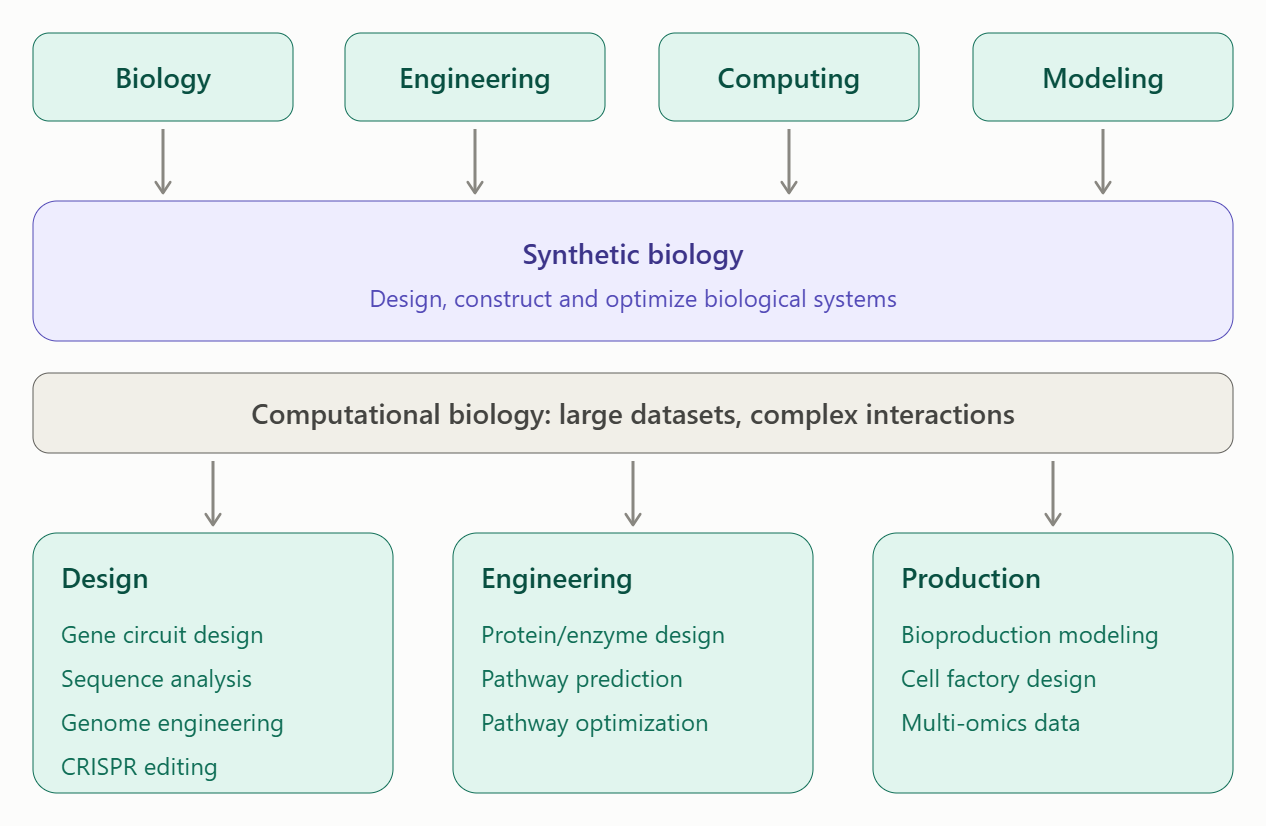
Computational approaches can contribute to :
- The design of genetic circuits
- The analysis of séquences génétiques
- L’optimisation des voies métaboliques
- L’ingénierie de génomes synthétiques
- La prédiction des voies biosynthétiques
- L’ingénierie des protéines et des enzymes
- La modélisation de la bioproduction
- La conception de stratégies d’édition génomique basées sur CRISPR
- L’intégration de données multiomiques
- La conception de cellules microbiennes usines pour la production biologique
Conception computationnelle des systèmes biologiques
La biologie synthétique moderne suit de plus en plus un cycle Design–Build–Test–Learn (DBTL), c’est-à-dire Concevoir–Construire–Tester–Apprendre. Les modèles computationnels peuvent être utilisés au cours de l’étape de conception afin d’explorer différentes constructions génétiques, voies métaboliques et configurations biologiques avant de procéder aux essais expérimentaux.
Les chercheurs peuvent utiliser des bases de données génomiques, des modèles métaboliques, l’apprentissage automatique et des outils d’analyse des voies biologiques pour évaluer les conceptions potentielles et prioriser les candidats à valider en laboratoire.
Cette approche computationnelle peut réduire le nombre de conceptions expérimentales à tester et permettre aux chercheurs d’explorer des espaces de conception biologique difficiles à étudier manuellement.
Ingénierie métabolique
L’metabolic engineering uses genetic and computational approaches to modify cellular metabolism to produce value-added compounds.
Computational models can help researchers study:
- Metabolic fluxes
- Enzymatic activity
- Bottlenecks in metabolic pathways
- The availability of precursors
- Cofactor requirements
- Competing metabolic pathways
- The allocation of cellular resources
Genome-scale metabolic models and machine learning approaches can thus contribute to the design and optimisation of microbial factory cells intended for bioproduction. Recent computational frameworks increasingly combine information from molecular, biological pathways, cellular, and process levels.
Artificial intelligence in synthetic biology
The artificial intelligence is increasingly integrated into synthetic biology. Machine learning and deep learning approaches can analyse vast biological datasets and contribute to sequence design, protein engineering, biological pathway prediction, and metabolic optimisation.
Recent approaches to biofoundries based on AI combine machine learning, generative AI, automation, and high-throughput experimentation to accelerate the Design–Build–Test–Learn.
The large language models are also studied for applications in synthetic biology and bioproduction. Recent work describes applications related to knowledge extraction, metabolic modelling, experimental design, and AI-assisted bioproduction workflows.
Design of biosynthetic pathways
An important application of computational synthetic biology concerns the design of biosynthetic pathways that enable the production of specific molecules.
Computational methods can combine information on :
- Chemical compounds
- Enzymes
- Biological reactions
- Metabolic pathways
- Genomic databases
- Enzymatic functions
Algorithms for retrosynthesis and biological databases can be used to identify potential pathways to convert available substrates into desired products. The computational design of biological pathways can thus help researchers evaluate different biosynthetic strategies before their experimental implementation.
CRISPR and genome engineering
Technologies based on CRISPR provide powerful tools to modify biological systems. When combined with computational analysis, CRISPR approaches can be used to study gene functions, modify metabolic pathways, and optimise genetically engineered organisms.
Computational tools can contribute to the design of guides, the selection of targets, the analysis of the genome, the interpretation of screening data, and the identification of genetic targets for metabolic engineering.
High-throughput CRISPR approaches also allow for the simultaneous study of multiple genetic modifications, thus contributing to the development of more complex microbial factory cells.
Applications
Synthetic biology and computational engineering are studied in many fields, including:
- The production of biofuels
- Pharmaceutical bioproduction
- Biologically engineered therapies
- Sustainable chemicals
- The production of biomaterials
- Industrial biotechnology
- Enzyme engineering
- Microbial factory cells
- Agricultural biotechnology
- Environmental biotechnology
The combination of synthetic biology, computational modelling, AI, and automation directs biological engineering towards increasingly data-driven and design-focused workflows.
Computational immunology
Computational immunology is an interdisciplinary field that combines immunology, bioinformatics, statistics, mathematical modelling, and artificial intelligence to study how the immune system responds to pathogens, abnormal cells, vaccines, and therapeutic interventions.
The immune system involves extremely complex interactions between immune cells, receptors, antibodies, cytokines, signalling pathways, and molecular targets. Computational approaches allow for the analysis of these interactions from genomic, transcriptomic, proteomic, and single-cell data on a large scale.
Modern computational immunology integrates data from technologies such as single-cell RNA sequencing, immune repertoire sequencing, spatial transcriptomics, proteomics, and high-throughput sequencing, in order to characterise immune responses with molecular and cellular resolution.
Computational immunology supports a wide range of research applications, including:
- Vaccine design
- Analysis of immune repertoires
- Modelling host-pathogen interactions
- Research on cancer immunotherapy
- Analysis and prediction of T cell receptors
- Analysis of B cell receptors
- Antibody engineering
- Discovery of immune biomarkers
- Analysis of cytokines and signalling pathways
- Modelling of immunological diseases
- Single-cell immune profiling
- The integration of multi-omic data
Single-cell immunology
Single-cell technologies have significantly expanded the ability to study immune cell populations individually.
The single-cell RNA sequencing can be used to characterise different types of immune cells and study changes in their transcriptional state during an infection, inflammation, cancer, or therapeutic treatment.
Computational analysis can help identify :
- T lymphocytes
- B lymphocytes
- Natural killer (NK) cells
- Macrophages
- Dendritic cells
- Monocytes
- Regulatory immune populations
- Rare or previously uncharacterised cellular states
Single-cell analysis can also reveal thecellular heterogeneity and help researchers study how immune populations evolve during the progression of a disease or treatment.
Analysis of immune repertoires
The adaptive immune system generates extremely diverse populations of T and B lymphocyte receptors.
Computational analysis of immune repertoires uses sequencing data to study the diversity, composition, and dynamics of these receptor populations.
Researchers can analyse :
- The sequences of T lymphocyte receptors
- The sequences of B lymphocyte receptors
- Clonal expansion
- Receptor diversity
- V(D)J recombination
- Antigen-associated immune responses
- Clonal relationships between immune cells
The combination of immune repertoire sequencing with single-cell transcriptomics can provide information on both the identity of receptors and the cellular state.
Vaccine research
Computational approaches can support vaccine research by helping researchers study the genomes of pathogens, antigenic candidates, immune responses, and potential molecular targets.
Bioinformatics can be used for :
- The analysis of pathogen genomes
- The identification of antigens
- The prediction of epitopes
- The comparison of sequences
- The modelling of immune responses
- The prioritisation of vaccine candidates
Machine learning approaches can help researchers identify trends in large datasets and prioritise candidates for experimental validation.
Computational predictions remain complementary to laboratory experiments and immunological validation.
Cancer immunology and immunotherapy
Computational immunology plays an important role in cancer research, as tumours dynamically interact with immune cells within the tumour microenvironment.
Single-cell and spatial technologies can be used to characterise interactions between :
- Tumour cells
- T lymphocytes
- B lymphocytes
- Macrophages
- Natural killer cells
- Dendritic cells
- Stromal cells
Computational analysis can help study the states of immune cells, tumour heterogeneity, cellular communication, and molecular signatures associated with treatment responses.
These approaches are studied in the context of immunotherapies such as the immune checkpoint inhibitors and other personalised therapeutic strategies.
Host-pathogen interactions
Computational models can also be used to study the interactions between pathogens and the host's immune system.
By combining pathogen sequencing with the host's transcriptomic and immunological data, researchers can study how infections modify cellular states and signalling pathways.
Applications include :
- Analysis of the genomes of pathogens
- Profiling the host's response
- Analysis of immune pathways
- Identification of biomarkers associated with infections
- Host-pathogen interaction networks
- Modelling disease progression
Single-cell approaches can provide additional resolution by revealing how different cell populations respond to the same infectious stimulus.
Artificial intelligence in computational immunology
Artificial intelligence and machine learning are increasingly being studied for the analysis of complex immunological data.
AI-assisted approaches can contribute to :
- Classification of immune cells
- The prediction of epitopes
- Analysis of T cell receptors
- The analysis of antibody sequences
- The discovery of biomarkers
- The prediction of immune responses
- The modelling of protein-antibody interactions
- The integration of multi-omic data
- The analysis of cellular communication
Deep learning, the graph neural networks, the transformers and other machine learning approaches can be applied to biological sequences, molecular structures, cellular networks, and high-dimensional single-cell datasets.
The large language models can also assist researchers in exploring scientific literature, organising biological knowledge, developing computational workflows, and interpreting complex immunological concepts.
Multiomics and systems immunology
Modern computational immunology increasingly integrates multiple levels of biological data.
For example:
Genomics → Transcriptomics → Proteomics → Immune repertoire → Spatial omics → Clinical data
The integration of these datasets can provide a more comprehensive view of immune responses and help researchers study the relationships between genetic variation, cellular states, molecular signalling, and tissue organisation.
The systems immunology uses computational modelling and network analysis to study the immune system as an interconnected biological system rather than as a set of isolated molecular components.
Future perspectives
The combination of séquençage unicellulaire, de l’omique spatiale, de l’analyse des répertoires immunitaires, de la multiomique, de l’intelligence artificielle et de la modélisation computationnelle crée de nouvelles approches pour étudier la biologie immunitaire.
Les recherches futures devraient de plus en plus relier les mesures cellulaires à haute résolution à des modèles computationnels capables d’intégrer plusieurs modalités biologiques. Ces approches pourraient contribuer à une meilleure compréhension des maladies infectieuses, du cancer, des maladies auto-immunes, des réponses vaccinales et des immunothérapies personnalisées.
Les prédictions computationnelles doivent rester soumises à une validation expérimentale, statistique et clinique appropriée avant leur traduction dans des applications biologiques ou médicales.
Défis scientifiques
Malgré des avancées majeures, la biologie computationnelle reste confrontée à plusieurs défis :
- La complexité des données biologiques
- La standardisation des ensembles de données
- La reproductibilité des données
- La capacité à mettre à l’échelle les pipelines computationnels
- L’intégration de données omiques hétérogènes
- L’interprétabilité des modèles d’IA
- La gestion éthique des données génomiques
- Le coût computationnel des simulations à grande échelle
La résolution de ces défis nécessite une collaboration interdisciplinaire entre biologistes, informaticiens, mathématiciens, cliniciens et ingénieurs.
Future perspectives
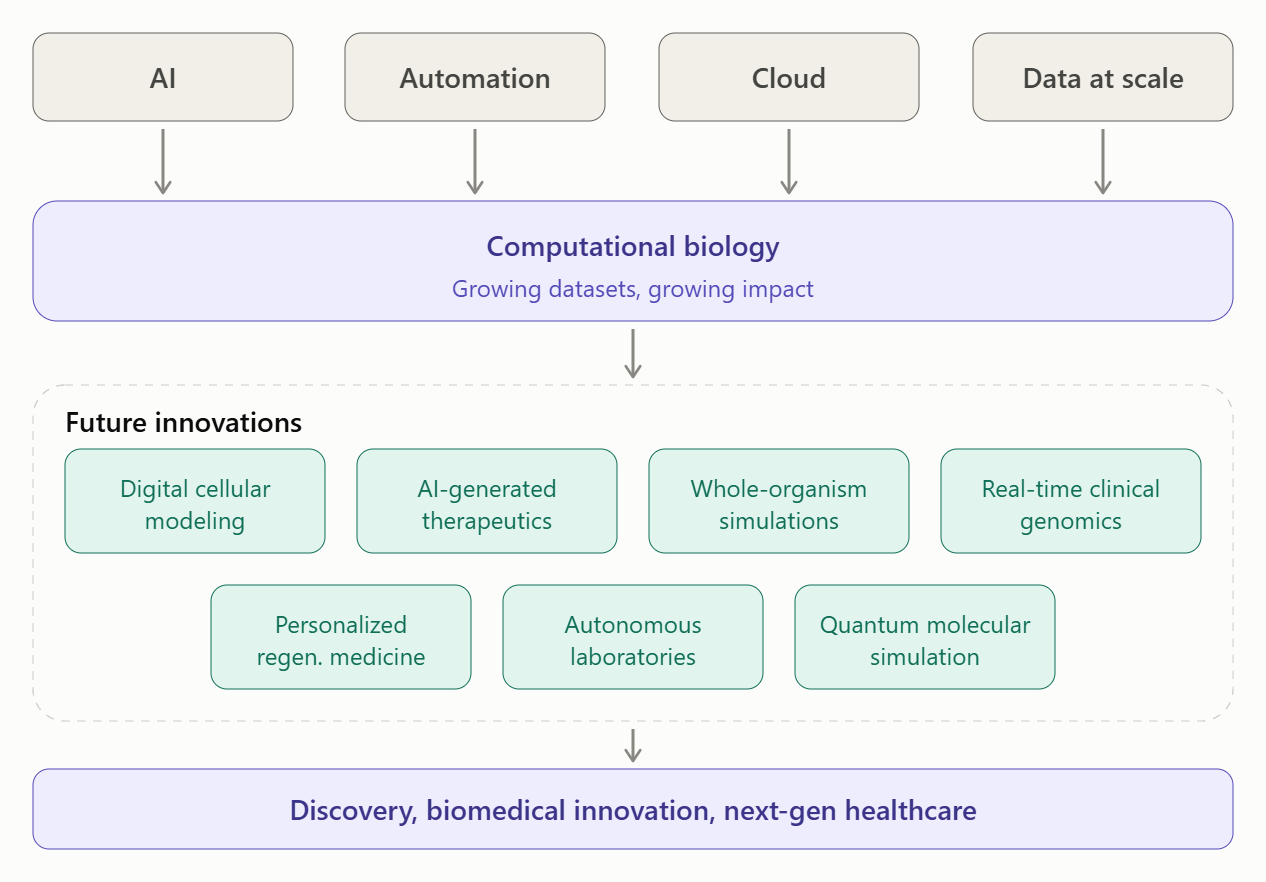
L’avenir de la biologie computationnelle est porté par l’artificial intelligence, automation, cloud computing and the generation of large-scale biological data.
Future innovations may include:
- Digital modelling of cells
- The generation of therapeutic molecules by AI
- Predictive simulations at the whole organism scale
- Real-time interpretation of clinical genomic data
- Personalised regenerative medicine
- Autonomous laboratory systems
- Applications of quantum computing to molecular simulation
As biological datasets continue to grow exponentially, computational biology will remain a central element of scientific discovery, biomedical innovation and next-generation healthcare.